Quick answer
A greens powder can add some vitamins, minerals and plant compounds to your diet, and some concentrate research shows benefits for select cardiovascular markers. It is not a substitute for whole vegetables and fruit, which supply fibre and a food matrix a powder cannot replicate. New Zealand guidelines recommend at least five vegetable and two fruit servings daily regardless.
- 01
A greens powder can add convenience, but is not equivalent to whole vegetables and fruit.
- 02
Dietary fibre content is one of the clearest differences between whole produce and most powders.
- 03
New Zealand guidelines recommend at least 5 vegetable and 2 fruit servings a day regardless of supplement use.
- 04
Check sugar content, serving size and whether claims on the label are realistic.
What is actually in a greens powder?
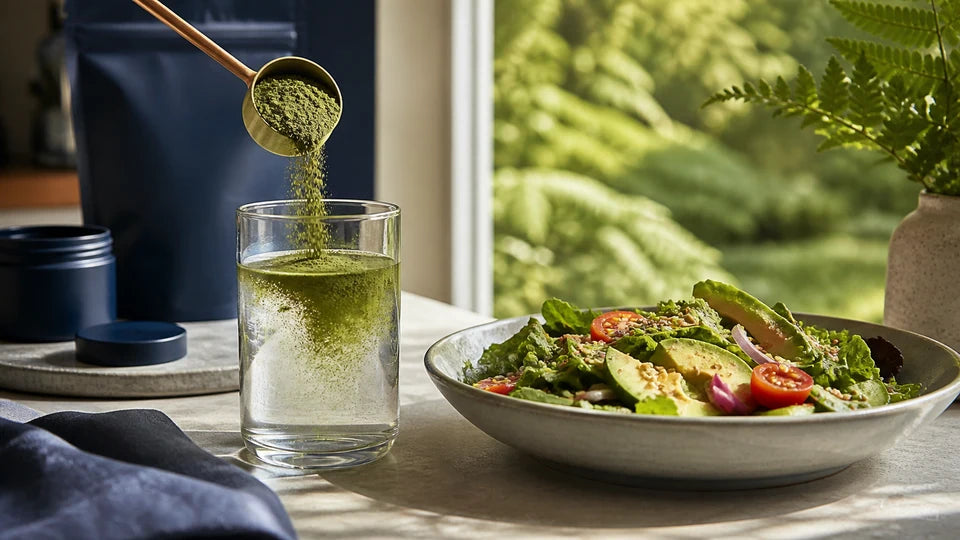
Greens powders typically combine dehydrated or concentrated vegetables, fruit, algae such as spirulina or chlorella, and sometimes added vitamins, minerals or digestive enzymes. Formulas vary considerably between brands, so the ingredient panel is more informative than the general "greens" category name.
Processing methods such as drying and powdering can reduce some heat-sensitive nutrients compared with fresh produce, and the resulting product generally contains far less dietary fibre than the whole vegetables and fruit it is derived from.
Can a greens powder replace vegetables and fruit?
Not directly. New Zealand's Eating and Activity Guidelines recommend at least five servings of vegetables and at least two servings of fruit a day for adults, in large part for the fibre, water content and variety of nutrients whole produce provides. A powder does not reliably replicate this fibre content or the broader food matrix of intact fruit and vegetables.
Some systematic review evidence on fruit and vegetable concentrate supplementation has found positive associations with specific cardiovascular risk markers, such as cholesterol, homocysteine and blood pressure, in certain populations. That is a narrower finding than claiming a powder is nutritionally interchangeable with eating vegetables and fruit.
Where might a greens powder add convenience?
A greens powder may suit people who reliably struggle to eat enough vegetables and fruit day to day, want an easy way to add variety to a smoothie, or are travelling and find fresh produce harder to access. In these situations it can function as a top-up alongside efforts to improve whole-food intake, rather than a reason to stop trying.
What should you check on a greens powder label?
Look at the full ingredient list, serving size, added sugar content and any specific claims made. Be cautious of language suggesting the product replaces vegetables, detoxifies the body, or delivers dramatic health outcomes without supporting evidence.
- Added sugar or sweetener content per serve
- Whether specific ingredient amounts are disclosed rather than hidden in a blend
- Realistic wording rather than claims to replace whole food groups
- How the product fits alongside your actual vegetable and fruit intake, not instead of it
People also ask
Frequently asked questions
Do greens powders count toward the recommended daily vegetable servings?
They are not generally treated as equivalent to a vegetable serving because of the differences in fibre and food-matrix content after processing. Whole vegetables and fruit remain the primary way to work toward New Zealand serving recommendations.
Are greens powders bad for you?
Not inherently. Most are intended as a dietary top-up. Problems tend to arise from marketing that overstates what the product replaces, or from products with high added sugar, rather than from the concept of a plant-based powder itself.
Should you take a greens powder instead of eating vegetables when you are busy?
Frozen and pre-cut vegetables are usually a more direct way to maintain vegetable intake on busy days, since they retain more of the fibre and food-matrix benefits than a powder. A greens powder can still be a reasonable addition on top of that, not a replacement for it.
Evidence and further reading
This guide provides general education, not diagnosis or individual medical advice. Follow product labels and speak with an appropriately qualified health professional when you are pregnant, nursing, taking medication or managing a health condition.
Keep learning